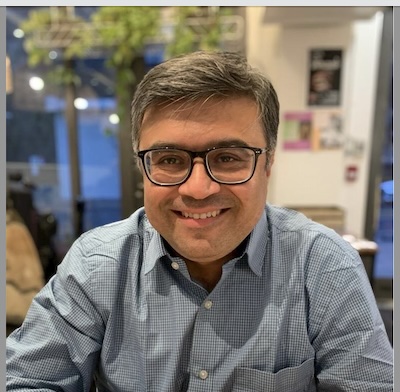
Misam Abbas
Staff AI Engineer at LinkedIn leading three cross-cutting GenAI reliability initiatives spanning pre-deployment evaluation, post-deployment monitoring, and AI-driven observability across the platform’s GenAI product portfolio.
- LinkedIn — Technical lead for GenAI reliability; LLM-as-a-judge evaluators, statistical annotation pipelines, pre-deployment evaluation framework, and agentic observability tooling.
- Dropbox — ML Tech Lead for Dash.ai; built hybrid lexical/vector search from scratch, bootstrapped evaluation with LLM-generated data, established the ML flywheel.
- Meta — User representation models (graph learning) serving billions; fairness metrics for recommender systems; diversity/engagement tuning across two product launches.
- Cengage Learning — Search and NLP systems for educational content platforms.
Conference speaker, peer reviewer (NeurIPS, IEEE Computer), and co-author of published AI research. MBA with Distinction from London Business School · B.Tech Computer Science from IIT Delhi · Fellow of BCS · IEEE Senior Member.
Experience
Staff AI Engineer • July 2024 - Present
Technical lead for three cross-cutting GenAI reliability initiatives spanning pre-deployment evaluation, post-deployment monitoring, and AI-driven observability across LinkedIn’s GenAI product portfolio.
- Designed and deployed instruction-tuned, embedding-based weak judges and LLM-as-a-judge evaluators to detect violating content across all GenAI products, monitoring millions of member interactions daily.
- Built statistical estimation pipelines for human annotation sampling, TPR/TNR calibration, and periodic prevalence calculations.
- Architected a pre-deployment reliability evaluation framework that gates all GenAI deployments to production with standardized safety and quality thresholds.
- Led development of an agentic research tool that surfaces behavioral patterns from product usage logs, enabling proactive identification of opportunities to better serve members.
Dropbox
Senior Machine Learning Engineer • May 2023 - July 2024
ML Tech Lead for Dash.ai, Dropbox’s AI-powered universal search product.
- Built the search capability from the ground up, architecting a hybrid system combining lexical and vector search.
- Used LLM-generated documents and queries to bootstrap offline search evaluation and establish early benchmarks.
- Established the ML flywheel for search including retrieval, ranking, evaluation, metrics, and experimentation.
Meta (previously Facebook)
Software Engineer (Machine Learning) • October 2018 - September 2022
Worked on personalization, user representation models, and fairness in recommender systems, delivering measurable impact on systems affecting billions of users.
- Developed general-purpose user representations using graph representation learning, driving adoption across Ads, FB Shops, and User Interest Profile teams.
- Adapted the technology for user interest modeling, enabling a partner team to achieve a 20% improvement on their primary metric.
- Developed ranking fairness metrics as part of Meta’s Responsible AI organization, collaborating with partner teams to integrate continuous monitoring.
- Analyzed popularity bias in sourcing models and developed diversity/engagement tuning approaches instrumental in two product launches.
Cengage Learning
Software Engineer • 2015 - 2018
Worked on search and NLP systems for educational content platforms, building foundational experience in information retrieval and natural language processing at scale.
Education
Indian Institute of Technology, Delhi
B.Tech Computer Science •
London Business School
MBA, Finance •
Dean's List
Conference Talks & Panels
Panel - Human oversight and LLMs: Ensuring trustworthy behavior
Generative AI Summit New York (AI Accelerator Institute) • New York • 2026-06-04
Discussed the critical role of human oversight in ensuring LLMs behave safely, ethically, and reliably, including frameworks for evaluation, red teaming, and governance to mitigate risk and bias as LLMs integrate into enterprise systems.
Panel - Frontier Evals & RL
AI Circle x Prolific • SignalFire Nomad, New York • 2026-03-26
Joined researchers from Google DeepMind and Cohere to discuss evaluation design best practices, reward modeling, post-training metrics, multilingual representation, and factuality and sycophancy in LM-safety.
Talk - Engineering Robustness: Challenges in Quality Assurance and Performance Evaluation for Production LLMs
NHI-CON (Aembit) • Virtual • 2026-01-27
Delivered a presentation on the challenges of quality assurance and performance evaluation for production LLMs, covering robustness engineering practices for real-world deployments.
Workshop - Building a Tool-Calling Agent from Scratch: Demystifying the Core Loop
Agentic AI Summit (ODSC) • Virtual • 2026-01-21
Led a hands-on workshop session demystifying the core agentic loop by building a tool-calling agent from scratch, as part of the Agentic AI Summit.
Talk - Building Trust Through Explainable and Auditable AI
Western New England University • Springfield, MA • 2025-08-28
Explaining Model Decisions both globally and locally using capabilities like SHAP values Trust in Generative AI by focussing on logprobs and model's chain of thought and reasoning traces
Panel Discussion on AI Applications, Compliance, & Ethics
Western New England University • Springfield, MA • 2025-08-28
Participated in a group discussion on AI compliance and ethics and addressed questions on balancing the need for explanations and transparency with the performance of the AI models
Talk - LLM System Evaluation the only moat in the GenAI era
Chief AI Officers Summit • New York • 2025-06-05
Presented a framework for objective-driven evaluation pipelines, mixing golden sets and automated scoring to accelerate model iteration.
Panel - Tackling hallucinations, drift & data decay at scale
LLM Ops Summit • Virtual • 2025-05-29
Shared strategies to detect prompt and embedding drift, and to design feedback loops that surface real-world hallucinations before they reach end users.
Panel - Data-Driven Innovation
SoCal AI Responsibility Summit • UCLA, Los Angeles • 2025-04-19
Student-led discussion on responsible data practices for GenAI.
Ask-Me-Anything with Misam Abbas
AI Beyond The Buzz (AMA) • Virtual (Lu.ma) • 2025-04-03
Wide-ranging Q&A on large-scale ML, LLM safety and career advice for AI practitioners.
Panel - Highly regulated environments: optimising generative AI systems in compliance-critical industries
Generative AI Summit • Washington DC • 2025-03-05
Finance and healthcare leaders discussed the technical and regulatory hurdles of launching GenAI while meeting strict data-control and audit standards.
Panel - Explainable AI & today's ethical challenges: balancing innovation, regulation and first-mover advantage
Generative AI Summit • Washington DC • 2025-03-05
Explored transparency, fairness and accountability trade-offs when shipping LLM products under emerging AI-governance regimes.
Publications
Matched Pair Calibration for Ranking Fairness
arXiv (CoRR) • Research Article • 2023-11-30
Introduces matched-pair calibration, a test that measures subgroup-level exposure bias in score-based ranking systems by comparing outcomes of near-identical item pairs.
Attribution Quality in AI-Generated Content: Benchmarking Style Embeddings and LLM Judges
arXiv (PrePrint) Accepted for publication at ICDMW • Research Article • 2025-10-14
Proposes a benchmark for assessing attribution quality in AI-generated content by evaluating style embeddings alongside large-language-model Judges to determine how well generated output can be traced back to original sources. Accepted for presentation at the ICDM RARA Workshop (Grounding Documents with Reasoning, Agents, Retrieval, and Attribution) on 11/12/2025. https://raraworkshop.github.io/
A smarter way to evaluate LLM applications
LeadDev • Technical Article • 2025-07-30
A structured evaluation framework for LLM systems that emphasizes defining clear objectives, using curated datasets pre-deployment, and ongoing quality assessment post-deployment via feedback and monitoring.
What Happens When You Change the Temperature of Your AI?
HackerNoon • Technical Article • 2025-10-14
Explains how the temperature parameter in large language models affects creativity, determinism, and output diversity, illustrating its real-world implications for reliability and user experience.
Meet HackerNoon Contributor Misam Abbas: The LinkedIn Engineer Building Trustworthy AI Systems
HackerNoon • Interview Feature • 2025-08-14
In this *Meet the Writer* interview, LinkedIn Staff AI Engineer Misam Abbas shares his journey from Meta and Dropbox to building trustworthy AI systems that balance ethics, diversity, and innovation. He discusses his writing process, fascination with AI temperature tuning, and the importance of explainability in large language models. Beyond code, Abbas champions mentorship, storytelling, and widening community participation in the evolution of AI.
Computer Method and System for Equity Financing by Retail Investors with Collective Due Diligence Funding
US Patent 7,827,081 • Patent • 2010-11-02
Describes a platform that lets retail investors pool commitments and due diligence costs to acquire private-equity stakes in startups.
Do Computers Understand our Emotions
Blog on Gale, a Cengage Company • • 2018-03-27
An introduction to sentiment analysis that makes the case that computers don't actually understand emotions, but they can make educated guesses about sentiment by analyzing text using computational methods like sentiment analysis. While these tools can process vast amounts of text quickly and identify general positive or negative sentiment, they still fall short of human-level performance and struggle with nuances like sarcasm.
Associations
Review & Jury Roles
NeurIPS 2025
Neural Information Processing Systems Conference • 2025
Served as an official ethics reviewer, assessing compliance of research submissions for both the Regular and the Datasets and Benchmarks tracks.
Computer.org Publication 2026
IEEE Computer Journal • 2026
Served as a peer reviewer for the IEEE Computer journal, completing two review assignments in early 2026 via Publons/Clarivate.
Computer.org Publication 2025
IEEE Computer.org Journal • 2025
Served as a reviewer for a paper in Responsible AI
AI@Berkeley Hackathon 2025
UC Berkeley • 2025
Judge for the student-run AI hackathon, scoring projects on impact, creativity and technical execution.
MindStudio Hackathon 2025
MindStudio • 2025
Judged participants in the Agent Hackathon organized by MindStudio.ai.
Globee Artificial Intelligence Awards 2025
Globee Awards • 2025
Judge for the Globee Artificial Intelligence Awards, reviewing cutting edge AI products and solutions.
Webby Awards (Category - AI General and Features)
IADAS (International Academy for Digital Arts and Sciences) • 2025
Judge for the Webby Awards for AI General and Features Category
Additional Links
Social Links
- Github: https://github.com/misamabbas
- Twitter: http://x.com/misamabbas
- LinkedIn: https://www.linkedin.com/in/misam
- Website: http://work.misamabbas.com